Helping Leaders Talk Purpose

With brands increasingly needing to be driven by an environmental and social purpose, short videos are helping leaders better promote their purpose and sustainable story.

Beyond the filming process itself, (see our post  How To Make Your Boss Look Great)  what’s the best way to create a great compelling story?

Unilever CEO Paul Polman talks about the company’s purpose at every opportunity. It appears everywhere – we even made a 60 second film about Purpose to launch the their Annual Report

In a recent article on story telling, John Coleman outlines a narrative structure that leaders have used to inspire audiences to get behind their business.*

Self, Us and Now!

  1. Start with the “self”. By sharing their own experiences and the values that these have informed, leaders can link their personal values to those of the business.

Steve Jobs’s address to the Stanford graduation class in 2005 is cited as an example of a great, real story of self. By sharing his personal history and how his experiences instilled within him a love of design, a desire to live passionately and authentically, graduates were able to understand more intimately his personal values and how these had guided his work at Apple.

  1. “Us” then connects these personal values, experience and aspirations to those shared by employees, customers or wider stakeholders. In this way, common shared values for the oganisation are developed.

Burt’s Bees – the America ‘all natural’ beauty products company – is cited a good example of how a business has applied this technique of story telling, where the story of Burt becomes the story of the company made into a compelling video that they show on their home page.
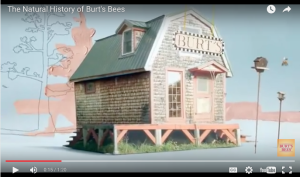
Screen Shot 2016-04-11 at 14.51.38

  1. “Now” refers to the close – a call to action for audiences to get behind the organisation’s purpose be it donating to a charity, responding to a job vacancy or recruitment drive.

Coleman cites St Jude Children Research Hospital whose purpose is ‘Finding Cures. Saving Children” Using simple direct and compelling videos and material, the charity tells the emotive stories of the children they serve to encourage empathy and new donations.

At Gripped we understand that being easy to view and share, video lends itself to telling a brand’s story. Also, with video increasingly taking the ‘lions share’ of all internet traffic, we help leading brands including Shell, Mars and Coca-Cola produce films that better connect their audiences with why they are in the business they are in and what they are trying to achieve.

To understand how we can help your leaders better tell their business story call Peter on 020 3285 8764 or email him [email protected]

*Harvard Business Review November, 2015, Motivate People

Why you shouldn’t play safe.

taking-risk

Dare to be risky when making a corporate film.

No one in a communications role got fired for making a film ‘like the last one’ or indeed one which looked like lots of other corporate films – but there’s the rub. To cut through the noise and clutter of thousands of others bits of communication your work has to stand out. To be different. And that involves taking risks.

A novel, creative treatment may be harder to sell-in to stakeholders, and in busy lives the path of least resistance can be appealing. But films with high talk-ability are usually films that take a creative risk. Put the effort in to getting a creative idea commissioned and you will reap the rewards.

Here are our top tips to get a memorable, original and effective film.

  1. Involve stakeholders in agreeing the brief but don’t share creative ideas with a wide audience – the idea will be killed by ‘feedback’.
  2. Give your agency the time and budget to do the creative thinking early on in the project. If there is no time everyone will revert to what has been done before.
  3. Practice ‘Greenhousing’ – where you give ideas time and space to grow, saying what you like about an idea. It is amazing how great ideas often emerge from one that you thought was a bad one at the start!
  4. You don’t have to spend a fortune on production to get a great film but you can’t skimp on the time spent to come up with a good treatment. The Thames Valley Police ‘Tea’ film about sexual consent is a good example here (see previous posting).
  5. Manage stakeholder expectations. When you are working on the brief make it clear that you are not expecting to produce ‘one like the last one’. Nobody likes a surprise.
  6. Don’t use the pitch process to try and get good ideas. No agency comes up with its best responding to an RFP or pitch document. Great ideas come when a client opens up to their agency and the two work together as partners.

We received a brief to make a training film to explain Return on Assets to a marketing audience. Not a very inspiring subject. But our creative animation was a million miles away from what you might expect and everyone – including the CEO – loved it!  You can see a short excerpt from it here https://vimeo.com/107701583

I you would like to put us to the test with your creative challenge drop us a line.

[email protected]


GET TO THE POINT!

Tired-Work-PixGood

Evidence shows that if you want people to watch your film it has to be short – the shorter the better. The reality is many corporate films are now watched at the desk (while checking emails) or on mobile devices, so your film needs to grab people immediately.

A good technique when writing scripts is the ‘Inverse Pyramid’ in which you hit your audience with the one thing they need to remember first, then important details and lastly the background info. It is often used by journalists and can clearly be seen in newspaper headlines.

The problem is that many reports, presentations and videos start with the background and take ages to get to the point.

So when you are looking at the structure and content of your next communication here are our suggestions:

  1. Write down the one thing that you want people to remember and get this up front in a ‘headline’ style.
  2. Be ruthless about stripping out content. At every stage ask yourself ‘is this essential?’
  3. Direct people to follow up sources of information so you don’t have to cover everything in the film. Your film can be like a 60 second advert that directs people to find out more from other company sources – like follow-up emails, websites or face-to-face meetings.
  4. Avoid including lots of background – that’s old news. Talk about what is new.
  5. If you are filming business leaders use an auto-cue so you can control what they say. If you ask someone to talk for 30 seconds without one they will often talk for way more than you need them to.
  6. A script for a 60 voice-over will typically be about 120 words long. It is really hard to get your message across in so few words – but if you succeed your film will be great!

We have lots of experience of helping clients to hone their message. If you would like to talk to us about how we can help you, drop us a line!

[email protected]

What we can learn from a film about sex

AAEAAQAAAAAAAASWAAAAJDkxYjcxYTFlLTdkNjMtNDRhZC1iZjc0LTk5NDMyNzNkYzI5ZA

You wouldn’t think a video about sexual consent would be a viral hit but the Thames Valley Police video – with over half a million views in its first week – has become just that. So what is so good about it as piece of communication?

A big idea.

The production company invested time upfront getting the big idea. There are 100s of ways this subject could have been approached and it would be easy to dive into one of the first that came up. But in spending time early on they have been able to deliver a brilliant film and spend almost no money on production!

The power of analogy.

In complicated or tricky areas using analogies can be highly effective. You don’t have to explain everything – the brain fills in the gaps allowing you to keep the piece short and focussed. They have picked a brilliant analogy here, which shows how ridiculous – or disgusting – it appears when you suggest forcing an un-conscious person the ‘drink tea’.

A tight script.

Having hit on a great analogy they kept the script really tight and to the point. They resisted the urge to cover every possible angle but kept ‘on-message, even making great use of repetition to drive it home.

A good tone of voice.

Avoiding temptation to be ‘trendy’ they kept it simple and to the point. They even managed to inject a bit of humour.

Visually interesting.

You might think it odd that working for a video production company I list the ‘look’ of the film last. While this definitely stands out, it is the above points that are the most significant things that make it a great film.

At Gripped we love using analogies – we created a whole campaign about Return on Investments for a global FMCG client that used a hot air balloon as the link to RoA. It was a ‘soar-away success’.

If you would like to talk about how we can help you get your message across do get in touch.

[email protected]

How to make your boss look great!

AAEAAQAAAAAAAAKSAAAAJDdmZmM0YWFmLWU4YjAtNDlhMi04ODczLThhNGRjODQ0OWE2Mw

If your job involves filming your CEO or senior leaders, the following tips from a company who have done it many, many times might help.

Be brave.

CEO’s that just nail it are rare. Even though you may be dealing with some big egos, our experience is that if you can make clear, helpful suggestions that will make them look good on camera – they want to hear your advice.

Have fun.

It can be quite stressful on set but a little light hearted humour does wonders to put everyone at ease and help the contributor perform at their best. Try and set the tone as soon as they walk in – a relaxed team will deliver a relaxed filming experience.

Be pragmatic.

Your contributor will want to spend as little time as possible. Don’t delay filming trying to correct a small visual problem, or fiddling with the positioning of a light. Get it all set up before they arrive and when they are there just spend the time filming.

Know when to step in and when not to.

If you hear a mistake it is far better to interrupt and step in. It takes two seconds to do a re-take but it’s a nightmare trying to patch over a factual error in the edit.

Water.

Always have a bottle of water ready. Even the most experienced people get ‘dry mouth’ and you don’t want to waste time running out for water. It shows you care and understand the stresses of filming.

Give the crew enough time to set up.

Yes of course you can point an IPhone and film in two seconds but it takes time to set up a great shot if you are using professional kit, sound and maybe lights or autocue. Allow the film crew enough time to set up before your start.

Run through.

If you are using an auto-cue get the script up on screen and read it through yourself – out loud and on camera. This will help you spot all the points in the script that read badly or cause you to trip up. This will make a real difference and increase the chance of the person your are filming being able to do it in one take.

If you would like us to help film your leaders call Peter Walter on 07775 566005 or mail [email protected]

A FUN way to connect your staff.

AAEAAQAAAAAAAANeAAAAJDk0NGIwNzMwLWJkMzQtNGU3ZS05YTVmLTgzNGM1NWNjZWMxMg

We saw this ad on YouTube and thought it would be a great way to connect staff from sites around the world.

https://youtu.be/l8Y5MDVhZDQ

Imagine if this installation was set up in your offices and factories? The person ‘in the poster’ could be a senior leader from ‘Head Office’, or a range of junior staff.

  • Build excitement around an up-coming event
  • Engender a sense of community
  • Create a sense of fun
  • Build huge talk-ability

Fun and effective!

If you would like to talk to us about using videos to connect with your staff drop us a line.

[email protected]